A data-driven manifesto exploring the erasure of werecoyotes in pop culture, literature, and media, and why it is time for a change.
See the dataWerewolf lore reaches back to antiquity, with the Epic of Gilgamesh containing one of the earliest known human-to-wolf transformations. In the classical world it's Petronius's Satyricon that includes a werewolf episode, and for Greek mythology we have the tale of King Lycaon which was transformed by Zeus as punishment for cannibalism, hence the word lycanthropy. This tradition appears across many cultures: Norse berserkers were thought to enter a wolf-like battle frenzy, Slavic folklore has the vukodlak, and the Navajo people talk about a skinwalker, a witch capable of assuming a wolf's form (amongst others). It is interesting to note that the Navajo word mąʼiitsoh meaning "big coyote", aka wolf, is not the only one relevant in our context, yenaldooshi is also used (in English: skinwalker) and sometimes "witch" is written as maicoh (w.r.t. mąʼiitsoh) in older books, especially before the changes in Navajo's orthography in the 1930s and mostly by non-native speakers. Please note that I am not a Navajo speaker and I use the available online information which appears limited on the topic.
In medieval European literature, Marie de France's lais: Bisclavret is an early example too. The French figure of the loup-garou is an iconic expression for the European werewolf. In the 20th century, the figure became a staple of popular culture through films like The Wolf Man and later works such as the Underworld series and Twilight.
Werewolves tend to be portrayed as cursed, tragic and/or romantic figures, they have power, primal fear, and sometimes nobility.
Werecoyotes appear less as a formal tradition and more as a fit-all box which we have shaped by modern interpretation. Now there are still beliefs that involve animal transformation, such as the yenaldooshi we talked about earlier for example, but these are not limited to coyotes and are going to differ significantly from our European perception; in Navajo belief, the coyote is primarily an omen and an emblem of witchcraft rather than a full shapeshifting identity.
The closest thing to a historical were-coyote tradition comes from Mesoamerica with the Aztec nahualli sorcerers. These were described in the Florentine Codex and could supposedly transform into coyotes among other animals, though this sits within a broader system of ritual shapeshifting rather than the curse-based lycanthropy (or rather Cynanthropy I suppose, we really need a word!) of European lore. The concept has surfaced very occasionally in modern fiction and television, most visibly in Teen Wolf, but never coalesced into a distinct and widely recognised tradition.
Ignored from wider recognition, werecoyotes never fully emerged as a distinct or widespread tradition in the first place. The coyote's dominant mythological role is of a trickster figure associated with cunning, change, and unpredictability, logically it feels uneasy alongside the victim/cursed template that defines the werewolves.
Data showing the disparity in representation
"Werewolf" is often searched in a seesaw pattern, "Werecoyote" doesn't seem to be part of any trend.
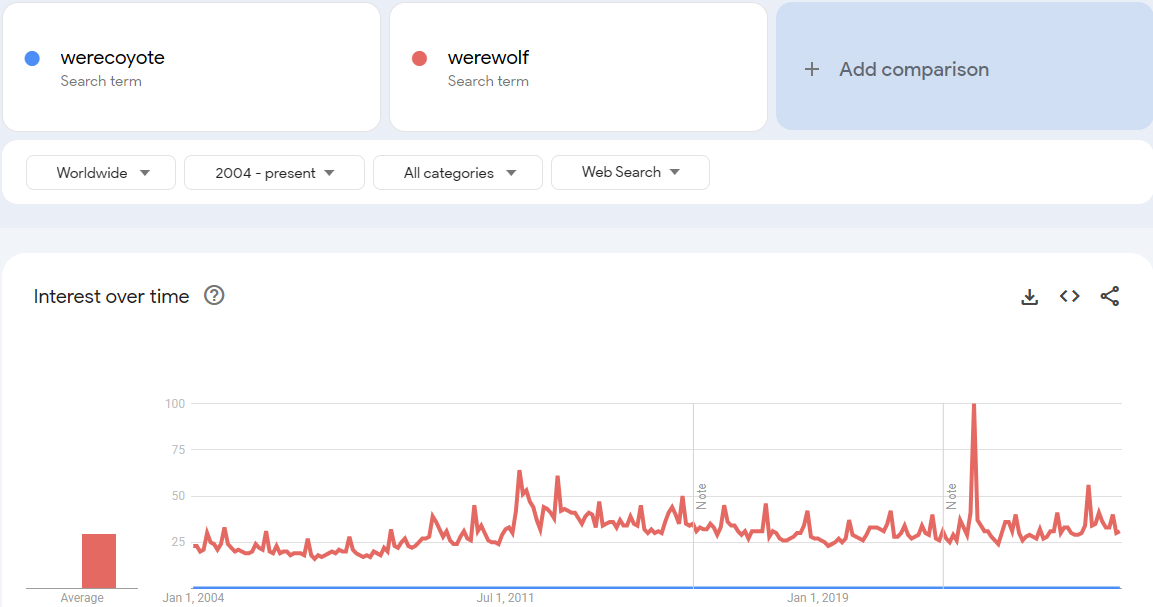
"Werewolf" picks up in the 80s and explodes early 2000, while "werecoyote" barely registers.
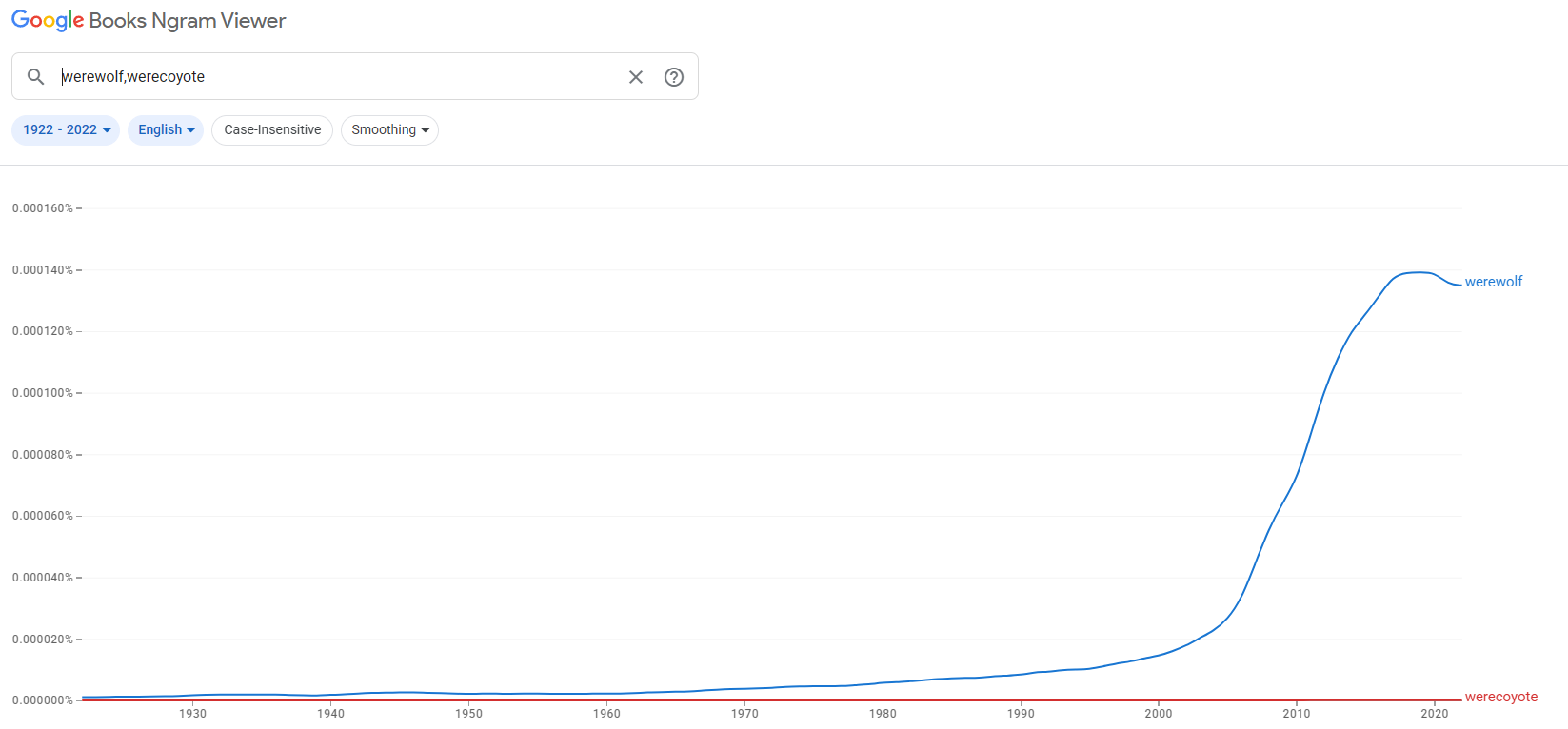
Twitter/X: Werewolf mentions: 30/hour vs. Werecoyote 5/month.
Instagram: #Werewolf (2M+ results) vs. #Werecoyote (56k+ results).
TikTok: #Werewolf (590k+ posts) vs. #Werecoyote (4k+ posts).
Court cases (USA): Werewolf: 37 vs. Werecoyote: 0.

Fanfiction: Werewolf tags on AO3: 68k vs. Werecoyote: 200.
TV Tropes: Werewolf: 26'300 vs. Werecoyote: 49.
YouTube: Werewolf: 142k videos vs. Werecoyote: 121.
Google Scholar: Werewolf: 42'000+ vs. Werecoyote: 14.
Internet Archive: Werewolf: 6'975 vs. Werecoyote: 2.
Github: Werewolf: 4k+ vs. Werecoyote: 0.
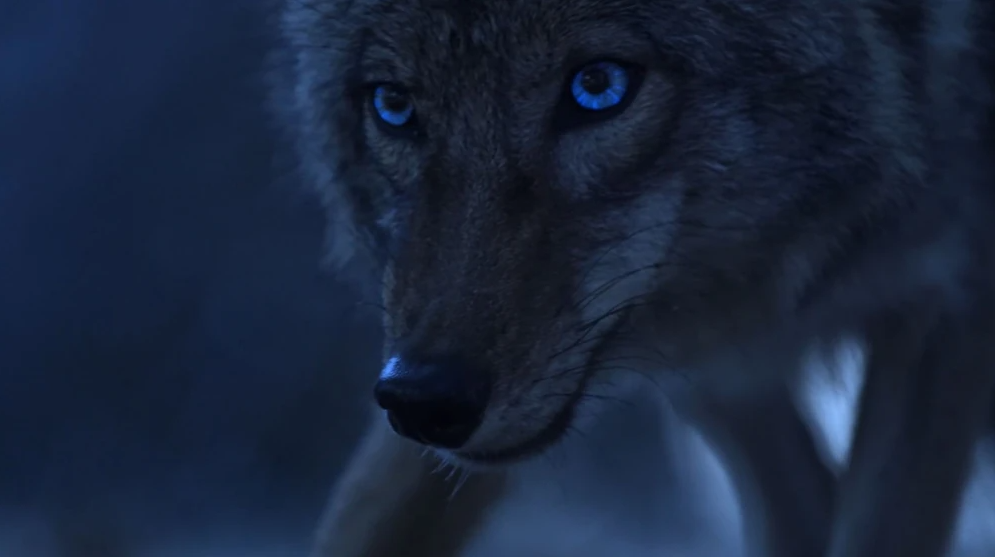
Steps to bring werecoyotes in the spotlight
Write werecoyote protagonists (e.g., a Teen Coyote reboot). Explore unique lore tied to desert survival, pack dynamics, or trickster archetypes.
Pitch to studios: Show them that werecoyotes offer fresh and unexplored narrative potential.
Demand representation: Petition for werecoyote arcs in current franchises (e.g., Supernatural spin-offs).
Support indie works: Highlight webcomics, novels, or games featuring werecoyotes (e.g., Winter Lost by Patricia Briggs).
Research folklore gaps: Why did the werecoyotes's myth fail to develop? Colonialism? Media bias? Try to explore the cultural and historical reasons behind their erasure. Be the difference.
Do not gatekeep: Accept other terms such as canine or coyote-shifter, skinwalker etc. Discuss their individuality, similarities/differences and joined representation (e.g. with vampires, kitsune)
Werewolves are ubiquitous; werecoyotes are erased. The data shows the imbalance isn’t accidental. Their fading pawprints need your help!
The next time you see a werewolf on screen ask yourself: Where’s the werecoyote? And wouldn't it be best if the pack was complete?